
Food Truck Insurance · California
Food truck insurance in California
Most states require a food truck to work from a permitted base and say so in an operating rule. California says it in the sentence that defines what a food truck is, and a definition behaves differently from a condition.
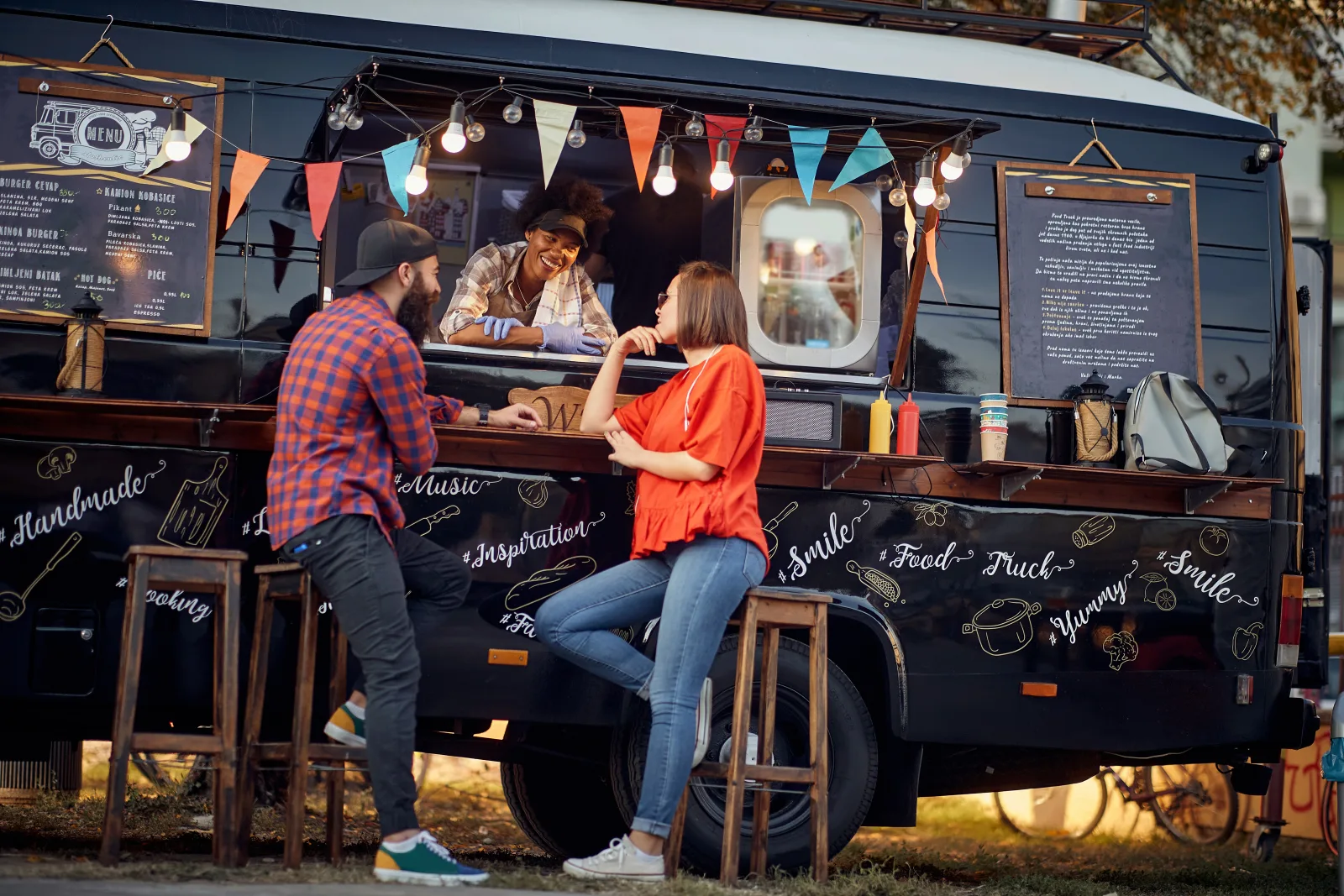

California writes the base inside the definition of the operation rather than attaching it as a separate condition. A unit without one is not a unit operating in breach; it is not the thing the code describes at all. This page follows that drafting, because it changes what an enforcement conversation is actually about. Arguing about a condition you have not met is a different conversation from not existing as the category.
The general problem of insuring a mobile unit — one asset that is workplace and vehicle in the same hour — is set out on the food truck insurance pillar, and this page assumes it rather than repeating it.
What is particular here is a piece of drafting. California does not bolt the base kitchen on as a requirement; it builds it into the definition, and that changes what an operator is arguing about when something goes wrong with the arrangement.
The second particularity is administrative. The rules are the state’s and the counter is the county’s, so an operator whose bookings cross county lines is dealing with more than one agency reading the same code.
The base is inside the definition, not attached to it
New Jersey writes servicing area into its rule. Wisconsin writes a base of its own name. Same building, different filing.
The Retail Food Code defines a mobile food facility at Health and Safety Code §113831 as a vehicle used in conjunction with a commissary or other permanent food facility. Read that slowly. The commissary is not a duty imposed on an already-existing category; it is written into the sentence that creates the category. An operator without one is not a mobile food facility that has fallen out of compliance so much as a vehicle that does not answer to the description.
That is a lawyerly distinction with a practical edge, and the edge shows up in how casually the arrangement is usually made. Time in a permitted kitchen gets bought on a handshake, or a favor, or a monthly figure agreed in a car park. The relationship is treated as a supplier arrangement, when the code is treating it as constitutive. If it lapses, the thing that lapses is not a convenience.
For the insurance file, the useful question is whose building it is. If you own the kitchen you cook in, you have a fixed premises with everything that implies — the structure, the equipment inside it, the stock, the people who work there. If you buy time in someone else’s, you own none of that and you still have property in it, and the document between you is the only thing that says who answers for what. Very few of those documents have been read since the day they were signed.
A cart and a truck are not the same class of thing here
The statute separates a compact mobile food operation — a pushcart, a stand, or another non-motorized conveyance — from a motorized facility, and the two are not held to the same requirements. That is a genuine fork in the road rather than a size gradient, and it matters at the point of quoting because the two operations are also not the same risk.
A cart has almost no vehicle exposure of its own and a great deal of pedestrian exposure. A truck has both, and the vehicle half of it is not a small half. Operators who begin with a cart and add a unit tend to carry the cart-shaped assumptions across, and the assumption that hurts is the one about how a policy responds while the thing is being moved rather than while it is being worked.
It is also worth saying plainly to anyone reading advice online: material written for one of these classes does not automatically describe the other, and California is one of the places where the difference is in the statute rather than in practice.
One code, and as many counters as counties you work
Enforcement and permitting sit with the county enforcement agency. The substantive standard is state law and the person who applies it to your unit works for a county, which is why an operator running several Bay Area or Southern California counties is dealing with several agencies reading one code.
Nobody should read that as a complaint about local government. It is a description of a workload, and the workload has an insurance consequence, because the operator who takes bookings across county lines is also the operator putting distance on the unit and, sooner or later, putting somebody else behind the wheel of it. A second driver appears the week the calendar stops fitting into one person’s day.
The practical instruction is to describe the working area accurately when the account is quoted. A radius stated honestly gets priced as it is. A radius left vague gets priced as it might be, and that guess is not usually made in the operator’s favor.
The vehicle half of a California food account
A unit that trades across county lines spends a serious share of its working life in traffic. Two entirely separate specialists will look at this business: one asks about extraction, gas and hot surfaces, the other asks about weight, distance and who was behind the wheel. Buy only the first conversation and you have insured the half of the day that produces the smaller bills.
Ask what limit California obliges you to carry and we will decline to answer in writing. Nobody working on this page read that requirement off its governing section, and an unread requirement acquires authority the instant it appears in print next to a lot of accurate material.
What can be said without any number is which questions decide the outcome. Who else drives the unit, and on what basis. What happens when a personal car is used for a supply run. Whether the vehicle is left loaded overnight, and where. Those are the answers that move a mobile account, and none of them is a limit.
Where the fixed exposure actually sits
California separates its major perils out of the property form: earthquake is excluded and placed on its own or through a difference in conditions policy, and flood is bought separately. Our California restaurant page works through that structure for a building, and there is no reason to argue it twice.
For a mobile operator the point is where the fixed exposure has gone. It has not disappeared — it has moved into somebody else’s building, and quite possibly into a building the operator has never asked a single question about. Stock in a shared walk-in, a spare unit stored in the yard, prep done in a kitchen whose own placement is thin: all of that sits in a structure the truck operator does not control.
The California FAIR Plan is worth knowing about in exactly that light. Its commercial fire cover is a named-peril form: a short list of causes, vandalism only if somebody paid extra for it, and nothing at all for the ordinary run of theft and water losses unless a wider policy has been built over the top. A base kitchen sitting on that alone is thinly protected, and if your stock lives there, some of that thinness is aimed at you. Your own certificate will never mention it.
What an event contract asks a mobile operator to promise
The documents that decide how a mobile claim goes are rarely insurance documents. One is whatever governs your time in the base kitchen. The other is whatever a venue, festival, campus or private host puts in front of you, usually late, usually by email, usually with a deposit attached.
Those agreements routinely ask to be named on your policy and sometimes specify what the policy must do. Signing first and checking later is the ordinary sequence and the wrong one. Beforehand the check costs nothing; afterwards it costs the job, and it costs it at the point where you have already turned other work away for that date.
Ten minutes with the paperwork before the season starts is the whole intervention. It is not a sophisticated piece of risk management and it is the one that most reliably prevents a bad month.
Major California food_truck markets
- Los Angeles. the largest mobile trade in the state and the most dispersed, where a week of bookings can cross more separate trade areas than most operators drive in a month anywhere else
- San Diego. beach, event and military-adjacent trade with a long outdoor season, which for a unit means high utilization and very little natural downtime for maintenance
- San Francisco. dense, permit-heavy pitches and a heavy weekday office trade, where the constraint is where you may legally stop rather than whether there is demand
- San Jose. corporate campus and business-park catering, which is where the contracts with insurance clauses attached tend to originate
- Sacramento. a capital and event calendar plus a working commuter trade, and a natural staging point for operators who work outward into the valley
- Fresno. the agricultural interior, where the price-sensitivity is real, the distances between bookings are long, and the operating economics of a unit look nothing like the coast
Learn more
Who we insure
Primary sources
- Cal. Health & Safety Code §113831 — mobile food facility defined — the definition itself, which is where the commissary requirement lives rather than in a separate operating rule
- CDPH — Retail Food Program — the state program page; the substantive code is state law while permitting and inspection are county work
- California FAIR Plan — commercial — relevant to the building your base kitchen sits in rather than to the unit; the commercial fire policy there is named peril
California food_truck insurance FAQs
Does California law actually require my truck to have a commissary?
It goes further than requiring it. Health and Safety Code §113831 defines a mobile food facility as a vehicle used in conjunction with a commissary or other permanent food facility, so the base is part of the definition rather than a separate operating condition. It is not a requirement bolted onto the class; it is part of what puts you in the class.
Is a pushcart treated the same as a motorized truck in California?
No. The statute separates a compact mobile food operation — a pushcart, stand or other non-motorized conveyance — from a motorized facility, and the two are not held to the same requirements. They are also not the same insurance risk, because one of them spends part of every day in traffic and the other does not.
Who issues the permit for a California mobile food facility?
The county enforcement agency. The substantive rules are state law under the Retail Food Code, but enforcement and permitting are county work, which is why the person inspecting your unit answers to a county rather than to the state.
We take bookings in several counties. Does that mean several agencies?
In practice yes. An operator working several Bay Area or Southern California counties is dealing with several enforcement agencies applying one state code. Plan the administrative time into the season, and tell your broker about the working area while you are at it — the counties you cross are also the miles you drive.
We rent time in someone else’s kitchen. Whose insurance covers our stock there?
That depends entirely on the agreement between you, which is why it is worth reading before a loss rather than after one. The building and its equipment belong to the kitchen owner’s program; your stock and your own equipment stored there usually do not, and neither party tends to have checked.
Our base kitchen is on the FAIR Plan. Does that affect us?
It can. The FAIR Plan commercial fire policy is a named-peril form — fire, lightning and internal explosion, with vandalism as a paid option — so a building placed there without a difference in conditions policy over it has real gaps. If your stock and spare equipment live in that building, some of those gaps are pointed at you.
Why will you not tell me the auto limit I need in California?
Because nobody here read it off its governing section, and we do not print requirements we have not read. What we will say is which facts move a mobile placement: the names on the driving schedule, whether a household car ever fetches supplies, and the kerb the unit sleeps against. Those change the outcome far more than a limit does.
Get a California food_truck insurance quote
Tell us what you run and where. Or call 317-942-0549.