
Food Truck Insurance · Wisconsin
Food truck insurance in Wisconsin
A copy of somebody else’s license has to be displayed inside your truck. That single requirement tells you most of what is distinctive about how this state handles mobile units — and two subsections further down do things that almost no other state does at all.
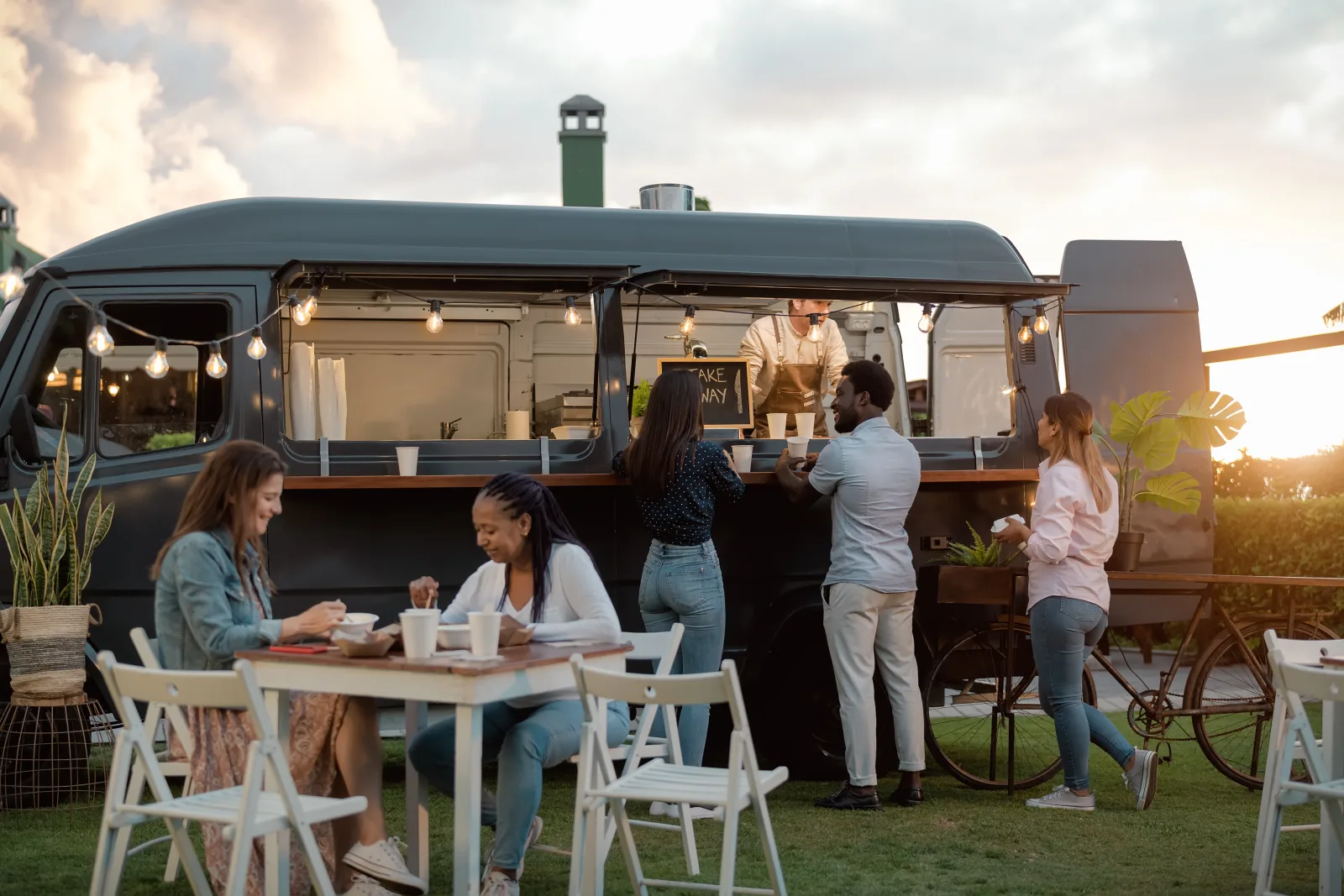

In Wisconsin a copy of somebody else’s license, posted in your serving window, is part of what makes your operation lawful — the base license is displayed by the truck. That is an unusual obligation and it is easy to overlook at fit-out. This page explains the display requirement and what has to be on it. A display obligation that depends on another party’s document also depends on that party keeping it current.
ATCP 75.07 is headed “Mobile retail food establishment base; licensing”, and it means the heading. Each mobile retail food establishment must have a base that holds its own license; a copy of that base license has to accompany the application and be posted in the unit; and the base must be adequate for the food preparation, cleaning, storage, water handling and waste handling the unit actually performs.
Wisconsin also does two things here that are worth an operator’s attention because they are rare. Subsection (7) requires a current base license issued by another state to be honored. Subsection (8) allows a variance to operate with no licensed base at all.
None of that changes the underlying difficulty of the class, which is that a truck is a kitchen and a vehicle competing for one quote — that argument is on the food truck insurance page. What Wisconsin changes is where the compliance sits and whose license you are relying on.
A copy of somebody else’s license, posted in your serving window
Louisiana runs on commissary and Virginia on commissary, which is why a single template rarely survives a border.
The requirement is small and it changes the relationship. A copy of the base license accompanies your application, and a copy is posted in the unit. Not filed. Not available on request. Displayed, in the vehicle, where an inspector standing at the window can see it.
That turns the base from a supplier into a visible part of your own compliance. If the base license lapses, expires or is not renewed, the document in your unit is describing a state of affairs that has ended, and you are the one standing next to it. Most operators never ask a shared kitchen when its license renews. In this state that question is a reasonable one to put in writing.
It has a straightforward insurance parallel, which is that the same arrangement decides who carries what. Whose policy covers the building. Whose covers the equipment you use there. Who is responsible for your stock overnight. Whether either of you expects to be added to the other’s policy. Wisconsin has already made the licensing side of this relationship formal; the insurance side is usually still a conversation nobody has had.
The out-of-state base, honored — with the condition attached
Subsection (7) goes further than most states are willing to: the regulator and its agents shall honor a current base license issued by another state. For an operator whose kitchen sits over a state line and whose trade sits on this side of it, that is a genuinely useful provision and it is not one you can assume in a neighboring jurisdiction.
Two limits have to travel with it or the sentence overstates itself. The honoring is conditional on the license holder meeting the relevant conditions under the section. And what is honored is the base license — not the mobile unit license. We found no provision under which the unit’s own license crosses jurisdictions, and we are not going to imply one.
The distinction is exactly the sort of thing that gets flattened in summaries and then repeated. If somebody tells you Wisconsin has reciprocity for food trucks, ask which license they mean. The provision that exists is about where your kitchen is allowed to be, not about where your truck is allowed to trade.
Subsection (8) exists, and it is the one worth asking about
Having built a base requirement, the rule then allows a variance to operate with no licensed base at all. That is unusual enough to be worth naming plainly, and it matters most to the operators for whom the base requirement is the hardest part of starting: a self-contained unit, a small menu, an owner without access to a commercial kitchen at a price that works.
A variance is a decision somebody makes about your specific unit, not a category you can put yourself in by reading a page. What we can tell you is that the door is in the rule, that it is worth asking about before you sign a lease on a kitchen you may not need, and that the person to ask is whoever holds licensing authority for you.
From an underwriting point of view a unit with no fixed base is a different animal and should be presented as one. Everything the base would have absorbed — cleaning, water, waste, storage, overnight parking, the security of your equipment when you are not with it — now happens somewhere else, and where that somewhere is becomes a question about the account rather than a detail.
Agent status, and why the office you deal with may not be the state’s
The license issues from the state department that oversees retail food, or from a city or county granted agent status under Wis. Stat. 97.41. That second route is the reason two Wisconsin operators can describe completely different experiences of the same rule while both being accurate.
An agent jurisdiction runs the licensing and inspection relationship locally. The rule text is the same; the office, the timetable, the person and the local interpretation are not. For a unit that works several counties this produces the familiar mobile problem of a compliance position that is plural rather than singular, and it is worth knowing which of the places you trade in hold agent status before you plan a season around them.
On a submission, this is one of the few pieces of context that genuinely helps an underwriter. An operator who can say which jurisdictions they hold permissions in, and which of those are agent jurisdictions, is describing a business that knows where it is allowed to be. That reads very differently from a file that simply lists the events it hopes to work.
The base has to be adequate for what you actually do in the unit
The rule does not just require a base — it requires an adequate one, measured against the food preparation, cleaning, storage, water handling and waste handling the unit performs. Adequacy is therefore a function of your operation rather than a property of the building.
That is a moving target in a way operators underestimate. A menu that grows, a second unit added to the same base, a switch from prepped-elsewhere to cooked-on-board, a change from a small water tank to a large one: each of those changes what the base has to be able to do, without changing anything about the base itself. The arrangement that was adequate in your first season may not describe your third.
The same growth is what quietly outruns an insurance program, and for the same reason. More equipment, more stock, more gas, more hours, more people, more mileage — none of which announces itself. A yearly conversation that asks what has changed on both sides of that relationship is worth more than any single coverage decision.
Transient only, and the line that carve-out draws
The base requirement carries an exception in its own first line: it does not apply to a mobile retail food establishment operating only as a transient retail food establishment. That word only is doing all the work, and it is worth reading twice before deciding it applies to you.
An operator who works a handful of events a year and an operator who works events plus a weekly pitch are not in the same position, even though both would describe themselves as doing events. The exception is drawn around what you do exclusively, not around what you mostly do, and drifting across that line is the easiest thing in the world to do in a good summer.
For an account, the honest version of this is a calendar rather than a self-description. Which days did the unit trade, where, and under what arrangement. That answers the regulatory question and the underwriting one at the same time, and it is a document most operators can produce in an hour from their own booking records.
A vehicle carrying a kitchen, on a file that names both
Everything above is about the kitchen half. The other half is a vehicle, and it is the half that produces the severe losses — a signwritten unit with cooking equipment, gas and stock in it, involved in a collision, is not a modest claim, and no amount of care at the window changes that.
It is also the half most likely to be underdescribed. A base across a state line means a genuine interstate drive on ordinary trading days. A summer working the northern events means long transits with a loaded unit. A crew rotating who drives means a driver list that has to be right rather than nominal.
Nothing numeric for that exposure appears on this page — no minimum, no limit, nothing at all. The federal responsibility rules people reach for cover hired freight crossing boundaries above a stated weight, so they seldom attach to a unit working its own state, and the state requirement governs instead. No Wisconsin number has been traced to a source we would cite, so the space is left empty rather than plausibly filled.
Major Wisconsin food_truck markets
- Milwaukee. the state’s largest mobile market, where pitch competition is direct, the event calendar runs long, and lakefront and festival trade concentrate a great deal of the year into a few weekends
- Madison. a capital and a campus in the same city, which produces weekday institutional demand and a separate term-driven trade that empties in summer
- Green Bay. a market where a single sporting calendar moves demand more than the weather does, with enormous single-day crowds and long quiet stretches between them
- Appleton. a valley market with several towns close together, so a unit based here can work a genuine rotation without the mileage a rural account carries
- Kenosha. close enough to a much larger metro across the state line that base location and interstate driving become live questions for an operator here
- Eau Claire. a western market with real distance between bookings, where the drive is a meaningful share of the operating day and a second driver becomes necessary sooner
Learn more
Who we insure
Primary sources
- Wis. Admin. Code ATCP 75.07 — Mobile retail food establishment base; licensing — the section itself: the base license, the posted copy, the adequacy standard, the honoring of an out-of-state base license and the variance that permits operating without a licensed base
- Wis. Stat. 97.30 — Retail food establishments; license — the licensing statute the rule sits under; note that the legislature’s paths require the subchapter segment, and the shorter form answers 404 with a full-length body
- Wis. Stat. 97.01 — Definitions — the definitions chapter; the single commissary reference elsewhere in this chapter belongs to vending machines outside the state and has nothing to do with a mobile unit
Wisconsin food_truck insurance FAQs
What does Wisconsin call the kitchen a mobile unit works from?
The base — and it says so in the heading of the rule that governs it, ATCP 75.07, “Mobile retail food establishment base; licensing”. Not commissary and not servicing area. The single commissary reference elsewhere in this part of the statutes belongs to vending machines outside the state and has nothing to do with a food truck.
Why do we have to display a copy of the base license in the truck?
Because the rule says so: a copy accompanies the application and is posted in the unit. The practical effect is that your base’s regulatory standing is visible inside your vehicle. It is worth knowing when that license renews, which is a question most operators have never asked the kitchen they rent from.
Our base is over the state line. Does Wisconsin accept it?
Subsection (7) requires a current base license issued by another state to be honored, subject to the holder meeting the section’s conditions. Two cautions travel with that: it is conditional, and it honors the base license rather than your mobile unit license. We found nothing providing for the unit license itself to cross jurisdictions.
Can a Wisconsin unit operate without any licensed base?
Subsection (8) allows a variance to do exactly that. A variance is a decision made about your particular unit rather than a category you can place yourself in, so the answer is to ask your licensing authority before committing to a kitchen lease. If you do end up with no base, say so on your submission — everything the base absorbs has to happen somewhere.
Who actually issues our license?
Either the state department responsible for retail food, or a city or county holding agent status under Wis. Stat. 97.41. Which one you deal with changes the office, the timetable and the local interpretation, without changing the rule. Find out which of the jurisdictions you trade in are agent jurisdictions before you plan a season around them.
We only work festivals. Does the base requirement reach us?
The requirement does not apply to a unit operating only as a transient retail food establishment, and that word only is decisive. Events plus a weekly pitch is not events only. It is an easy line to cross in a good summer, so keep a calendar of where the unit actually traded rather than relying on how you describe the business.
What should we tell an underwriter that a typical submission leaves out?
Which jurisdictions you hold permissions in, whether your base is yours or rented, whether it sits in this state, and who besides the owner is authorized to drive. Those four answers describe the account. Most submissions describe a menu instead.
Does this page cover the food-safety rules for a Wisconsin kitchen?
No — deliberately. The certified-manager requirement and the code that carries it are argued on our Wisconsin restaurant page, and repeating them here would tell you nothing new about a truck. This page stays on the rules that only apply because the kitchen has wheels.
Get a Wisconsin food_truck insurance quote
Tell us what you run and where. Or call 317-942-0549.