
Bar Insurance · California
Bar insurance in California
California is the state most often described backwards. The legislature immunized the seller, told the courts that consumption rather than service is the proximate cause, and left a single exception that requires two separate facts to be true about the same patron at the same moment.
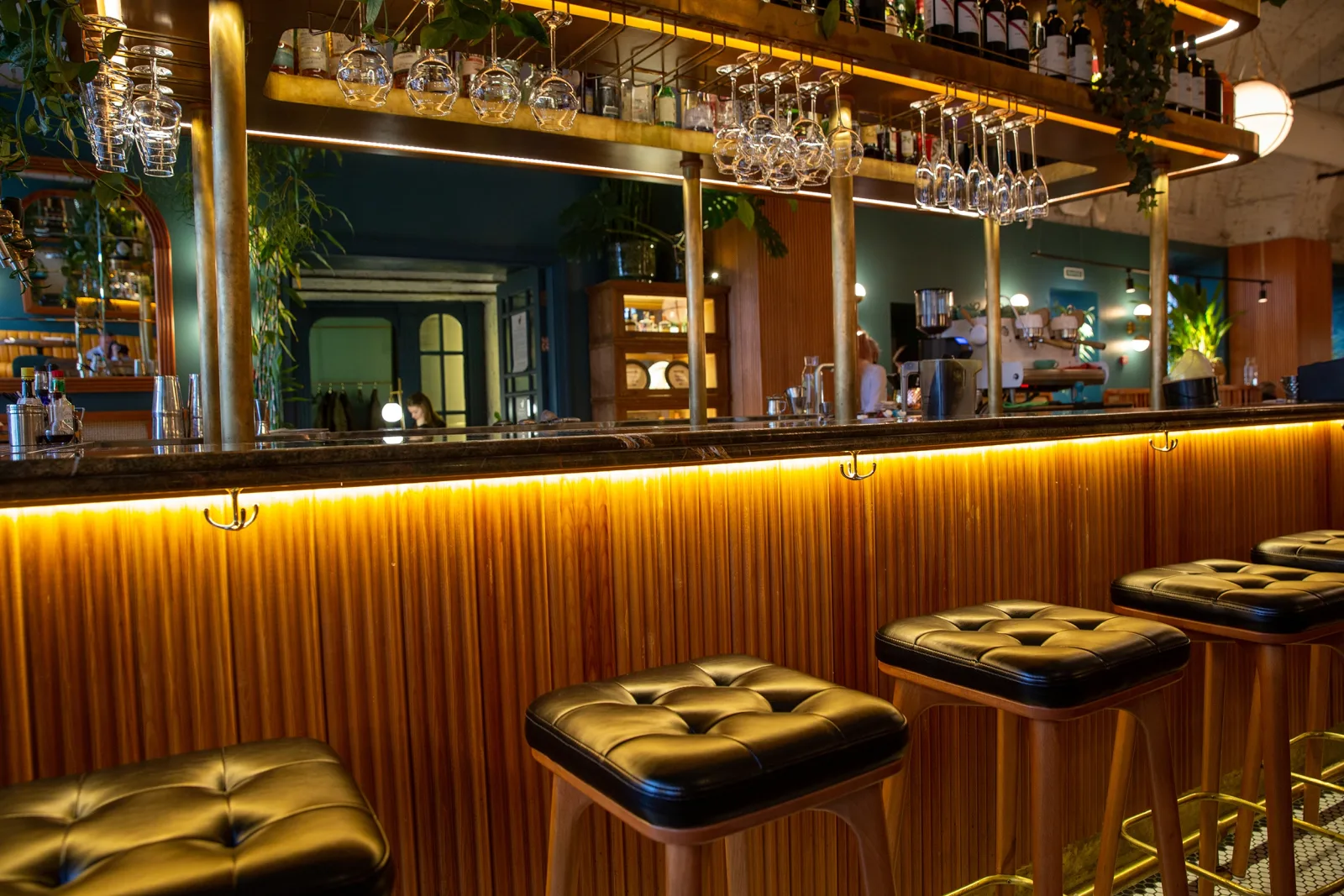

In California the license type is the line between two trades. The eating-place series and the public-premises series are different businesses to the department, and the choice is made before you open rather than discovered later. The statute protects the seller and then draws one narrow exception; the page identifies where that exception actually falls.
Start with the license, because in California the license is the line between the two trades. The eating-place series and the public-premises series are the operative distinction: Type 41 for beer and wine at an eating place, Type 47 for on-sale general at an eating place, against Type 42 and Type 48 as the public-premises equivalents, with Type 40 for beer alone and Type 75 for a brewpub-restaurant.
An eating-place license is issued to a business whose room is built around food. A public-premises license is issued to a business whose room is not. That is a statement about what you are before it is a statement about what you may pour, and it is the first thing that has to agree with everything else in a submission.
Then the liability rule, which is the part almost every general article gets the wrong way round. California statutorily immunizes the seller. The exception is real but it is narrow, and it is conjunctive: it needs two things about the same patron, together.
How that cover behaves in its own right — which claims the standard wording sets aside, how assault and battery is dealt with inside the form — belongs to the liquor liability page and is not restated here. This page carries what California does to the exposure sitting underneath it.
Eating place or public premises: the department draws the line for you
The Department of Alcoholic Beverage Control licenses on-premise service, and for this trade the operative distinction is not between beer and spirits. It is between the eating-place series and the public-premises series.
Type 41 and Type 47 are the eating-place licenses — beer and wine in the first case, on-sale general in the second. Type 42 and Type 48 are their public-premises equivalents. Type 40 covers beer alone, and Type 75 is the brewpub-restaurant license, which exists because a room that manufactures what it serves is not quite either of the other two things. Sorting rooms by what they are rather than by what they pour is not this department’s invention — the Class A permit types our Louisiana bar page unpacks reach a comparable sorting through a description of the room instead of a number.
For a placement, the series matters twice over. It tells an underwriter what kind of room you are running before you describe it, and it constrains what you can honestly claim about your operation later. A file that describes a food-led business while holding a public-premises license is a file with an internal contradiction in it, and contradictions get resolved conservatively.
The brewpub case deserves its own sentence, because a room that brews what it serves has manufacturing exposure standing inside a hospitality building. The license records that fact; the program has to answer for it. It reshapes the property schedule, it raises a products question, and it can change how staff who work on both sides of the wall are classified.
Where the food side genuinely is the business, the placement moves and so does the page — the California restaurant side carries the food code, the certification duties and the property chain in full.
The statute protects the seller, and then draws one narrow line back
Business and Professions Code section 25602(b) provides that a person who furnishes alcohol is not civilly liable to an injured person. Subsection (c) goes further and abrogates the earlier case law in favor of the rule that consumption rather than service is the proximate cause of any resulting injury. Civil Code section 1714(b) states the same rule.
That is the general position, and it is the starting point rather than an afterthought. The California legislature looked at a body of judge-made liability, decided it had gone somewhere it did not want, and legislated it back.
Section 25602.1 is the exception, and it is where operators are most often misinformed. It gives a cause of action against a licensee who furnishes to a patron who is both obviously intoxicated and a minor. Both. The word joining those two conditions is and, and it does the entire work of the section.
Serving an obviously intoxicated adult does not, standing alone, open a California licensee to civil dram shop liability. That sentence is uncomfortable to write and it is regularly disbelieved, which is exactly why it is worth stating plainly and then bounding carefully. Shelter drawn this wide is uncomfortable to write anywhere and it is not unique to this state: the immunity our Delaware bar page reports, and the two separate findings standing behind it, needs bounding of exactly the same kind.
Here is the bound. That statement is about civil liability under that section. It says nothing about what the department may do to your license, nothing about liability theories outside this statute, and nothing about the ordinary consequences of running a room badly. An operator who reads it as permission has read a liability rule as an operating standard, and those are different documents.
The social host rules are a different actor, and they get quoted at you
There is a specific confusion in California that is worth arming yourself against, because it turns up in general articles, in training material and occasionally in advice.
Civil Code section 1714 contains further subsections — (c) and (d) — that govern social hosts. A social host is a private individual furnishing alcohol in a personal capacity. It is a different actor from a licensed commercial operator, subject to a different rule, and the subsections that address it must not be cited as the licensee rule.
The reason this matters practically is that the social host material sounds more dangerous, which makes it more quotable. An operator who has been shown those subsections and told they describe their exposure will make decisions — about staffing, about training spend, sometimes about whether to buy cover at all — against a rule that does not apply to them.
The correction runs in both directions and neither direction is comfortable. Some operators are frightened by a rule that is not theirs. Others, told that California immunizes the seller, conclude there is nothing to insure. Both have stopped reading too early.
The practical instruction is unglamorous: when someone quotes a section at you, ask which actor it governs. In this state that single question resolves most of the confusion in circulation.
Dense cores, late hours and the crowd that turns over
California’s bar and nightlife concepts cluster in the dense urban cores, and density is the variable that moves a liability file more reliably than anything about the drinks list.
As an evening runs on, a room changes in ways that can be measured. It gets fuller. Each member of staff is watching more people than they were at eight. More of the customers arrived alone, or in pairs that have since dissolved into the crowd. Altercation exposure follows those conditions closely, which is why crowd management, capacity control and the door are underwriting subjects in their own right rather than operational detail.
California adds a particular reason to watch one variable above the others. The statutory route to a licensee cannot be traveled unless the patron was a minor, so age is not one control among several here — it is a required element of the only cause of action the section leaves standing. A room that verifies age reliably has closed that route rather than merely narrowed it, and no other control on the floor does the same thing.
Entertainment complicates this in an obvious way and in a less obvious one. The obvious way is that a programmed night is larger, later and harder to see across. The less obvious way is that a bar-led room running live music draws an audience a food-led room does not, and the age profile of that audience is precisely the variable the statute has made load-bearing. So the questions that earn their place are who books the acts, who supplies the gear, who is on the premises without being on your payroll, and what each of them has contractually taken on — because the venue is normally the party left explaining how many people were inside.
Two California segments sit slightly outside that picture and deserve to be described rather than folded in. Wine country and coastal tourism corridors produce rooms whose season is a real operating variable, with staffing and hours moving materially across the year. And tasting rooms with service blur the line between manufacturing and hospitality, which is a schedule question and a products question at the same time.
The state also originates formats before they travel, which produces a specific and under-appreciated problem: the operator in front of you is unusually likely to be running something no standard classification was drafted with in mind. The remedy is description. Say what actually happens in the room, at what hours, to how many people, and let the classification follow the description rather than the other way about.
Rebuilding, reopening, and the claim that has not arrived yet
The property half of a California file is a large subject, and it sits on the property side of the program — earthquake placed separately, and a residual-market property policy that is named peril and therefore incomplete standing alone. The California restaurant page carries all of it, and a building does not change its character because a bar occupies it rather than a dining room.
What is different for a bar is what a dark building does to the liability. A closure — seasonal, or forced by a loss — stops the takings and stops the pouring. It leaves untouched every evening the room has already worked.
And a claim reaching back to one of those evenings has two facts to establish about a single patron: obvious intoxication, and age. Both are proved years later out of whatever your room can still produce — the identification check, the till record, who was pouring, what the cameras held. A rebuilding year is exactly when that material goes missing, because the equipment holding it is in a skip along with the fit-out.
So two questions are worth settling while cover is being moved rather than afterwards: whether the policy answers by reference to the evening itself or to the date a claim was first made, and whether the run of policies behind you has a gap in it. Where an umbrella sits over the program, put the same questions to the layers beneath — an excess layer is only ever as unbroken as what it was written above, and terms underneath it can shift without anyone re-reading the layer on top.
The license belongs in that conversation too, and here it belongs emphatically. A suspension, a disputed renewal, a transfer — each one changes the operation the cover was written against, and this is a class underwritten against a licensed business. Tell your agent the day the status moves. A policy describing a business that has stopped existing in that form is a discovery best made somewhere other than a claim file.
Age is an element of the claim, not a precaution
Almost every control in a bar does one of two things. It lowers the chance of something happening, or it improves how the business answers for it afterwards. Checking identification in California does neither, or rather does something else in kind. The statutory route to a licensee cannot be walked unless the patron was a minor as well as obviously intoxicated, so a room that verifies age reliably has not made the claim less likely. It has removed one of the things the claim is assembled from. An age condition sitting among the elements rather than among the precautions turns up elsewhere in this set — our Kentucky bar page treats an age condition as a boundary rather than as one control weighed among several — and in both places the instruction that follows is that a control removing an element has to work every single time.
That is worth stating carefully, because it is easily heard as an invitation to relax and it is the opposite of one. A control that eliminates an element eliminates it only while it works every time. One failure on a full Saturday puts the whole route back, and it will not look like anything at the time — it becomes visible years later, when somebody goes looking for what happened at the entrance that night and finds whatever the room kept.
It also changes what your own history says about you. Read for its total, a loss run is a statement about scale. Read for who the customers were, it is a statement about the door, and in this state the second reading is the one with statutory purchase. A pattern of incidents involving young customers is a comment on a control. A single large altercation claim among adults is a comment on an evening.
And it puts unusual weight on the people doing the checking. Whether they are employed or engaged under contract is not an administrative detail here: responsibility for their conduct follows the way the relationship actually runs — who directs the work, who sets the hours — rather than the heading on the agreement. Where those two describe different arrangements, one night produces a liability question and a payroll question together, and general liability is only half of what gets asked.
Major California bar markets
- Los Angeles. The widest range of licensed formats in the state inside one market, from neighborhood rooms to large late-hours venues with programmed entertainment and contracted door staff. Concept turnover is fast enough that the room being described frequently has no obvious classification at all, which puts the burden on describing it accurately rather than reaching for a category.
- San Diego. A dense coastal nightlife district sitting alongside a deep brewery and taproom trade, so manufacturing exposure and hospitality exposure regularly share a building and sometimes share a license. Visitor-weighted crowds through the warm months mean the age check is being made on strangers all summer — and in this state the age check is the element the statutory claim cannot do without.
- San Francisco. Compact, high-value premises with dense evening crowds, and neighboring rooms sharing one street-level flow between them, which turns an incident a few steps from your door into a question about where your premises stop. What goes into a fit-out here is worth a great deal against the floor area it occupies, so the property schedule and the business income wording carry more weight than the square footage would suggest.
- San Jose. A market built on a large weekday working population, which flattens the week and pulls the busiest hours earlier than the coastal cores manage. Newer multi-tenant buildings are common, so the landlord’s certificate requirements and the boundary of a shared premises reach the placement before the liquor question does.
- Sacramento. A capital-city trade with an event-driven and legislative-calendar rhythm layered over a steady local base, so demand arrives in identifiable spikes rather than as a flat line. Neighborhood rooms with a stable regular crowd sit close to venues running programmed entertainment, and the two are genuinely different underwriting propositions on the same street.
- Fresno. An agricultural-interior market running on a different economy from the coastal cores, with price-sensitive rooms and a customer base that is local rather than transient. Where staff know most of the room by sight, age is settled by recognition long before anybody is asked for a card — worth putting on an application, because it is not something a reader will assume.
Learn more
Related coverage
Who we insure
Primary sources
- California ABC — license types — the department’s own table of license types, which is where the eating-place and public-premises series sit next to each other and the difference between them becomes visible
- Bus. & Prof. Code § 25602 — furnishing, and civil liability — the immunity itself, and the subsection that abrogates the earlier case law in favor of consumption rather than service as the proximate cause
- Bus. & Prof. Code § 25602.1 — the exception — the narrow cause of action against a licensee, and the two conditions it requires together rather than separately
- Civ. Code § 1714 — the same rule, and the social host subsections — subsection (b) states the licensee rule; subsections (c) and (d) govern social hosts, a different actor entirely, and are regularly quoted at licensees as though they were not
California bar insurance FAQs
Is a California bar liable for serving an obviously intoxicated adult?
Not on that fact by itself. Business and Professions Code section 25602 immunizes the person who furnishes alcohol, and provides that consumption rather than service is the proximate cause. The exception at section 25602.1 requires the patron to have been obviously intoxicated and a minor — the two conditions together. All of that describes civil liability under those sections. It describes nothing about what the department may do to a license.
What is the difference between an eating-place license and a public-premises license?
It is the difference between a business built around food and one that is not. Type 41 and Type 47 are the eating-place licenses, for beer and wine and for on-sale general respectively. Type 42 and Type 48 are the public-premises equivalents. Which one you hold is a public description of your trade, and it needs to agree with how the rest of your submission describes you.
Someone showed me a Civil Code section that says we can be liable. Which is right?
Check which actor the section governs. Civil Code section 1714(b) states the licensee rule and matches the Business and Professions Code position. Subsections (c) and (d) of the same section govern social hosts — private individuals furnishing alcohol in a personal capacity — and they are a different rule for a different actor. They are frequently quoted at licensed operators as though they applied to them.
If the statute protects us, is liquor liability cover still worth buying?
Yes, because the immunity answers one route to liability and not the consequences of an incident. General liability wording stands apart from alcohol claims however the statute reads, so an alcohol allegation arrives at cover you arranged on purpose or it arrives at nothing. Defense costs run whether or not the two conditions are ultimately met, the exception is live wherever an age check failed, and what the department may do to a license runs on its own track entirely.
We hold a brewpub-restaurant license. Does that change the placement?
It usually does, because Type 75 describes a room that manufactures what it serves. Production exposure moves inside a hospitality building, which reshapes the property schedule and raises a products question that a room only pouring what somebody else made never has to answer. It can also affect how staff who work on both sides of the wall are classified. Describe it as two activities under one roof rather than as a single hybrid and the schedule usually comes back better.
Does our license type affect what an underwriter charges us?
It affects what they understand about you, which comes first. The series says whether your room is built around food or around service at the bar, and that is a proxy for hours, crowd density and revenue mix — the variables that actually drive a bar liability file. The most useful thing you can add to it is your own alcohol-to-food revenue split, straight out of your records.
Do door staff have to be our employees in California?
That is not the question a claim will ask. What matters is who answers for their conduct, and that follows the way the relationship actually runs — who directs the work, who sets the hours, who can end it — rather than the heading on the agreement. Where the paperwork and the practice describe different arrangements, a single night produces a liability question and a payroll question together, which is a reason to look at it between renewals rather than in the week after an incident.
Our building is out of action after a loss. Does the liquor exposure pause?
No. Evenings already worked keep their claims, and one can surface years later. A rebuilding year is also the year your evidence is most at risk — and in this state the evidence matters unusually much, because the statutory claim needs proof that the patron was obviously intoxicated and under age, and that proof is largely made of things the room recorded at the time. Confirm which policy answers, by reference to the evening or to the date of the claim, and confirm the run behind it, before cover moves rather than after.
Get a California bar insurance quote
Tell us what you run and where. Or call 317-942-0549.