
Food Truck Insurance · New Jersey
Food truck insurance in New Jersey
Read the rule that governs a mobile unit in this state from end to end and you will not find a permit in it. It sets the standard in detail and then leaves the issuing to somebody else — which changes who you talk to, and changes what your file has to say about it.
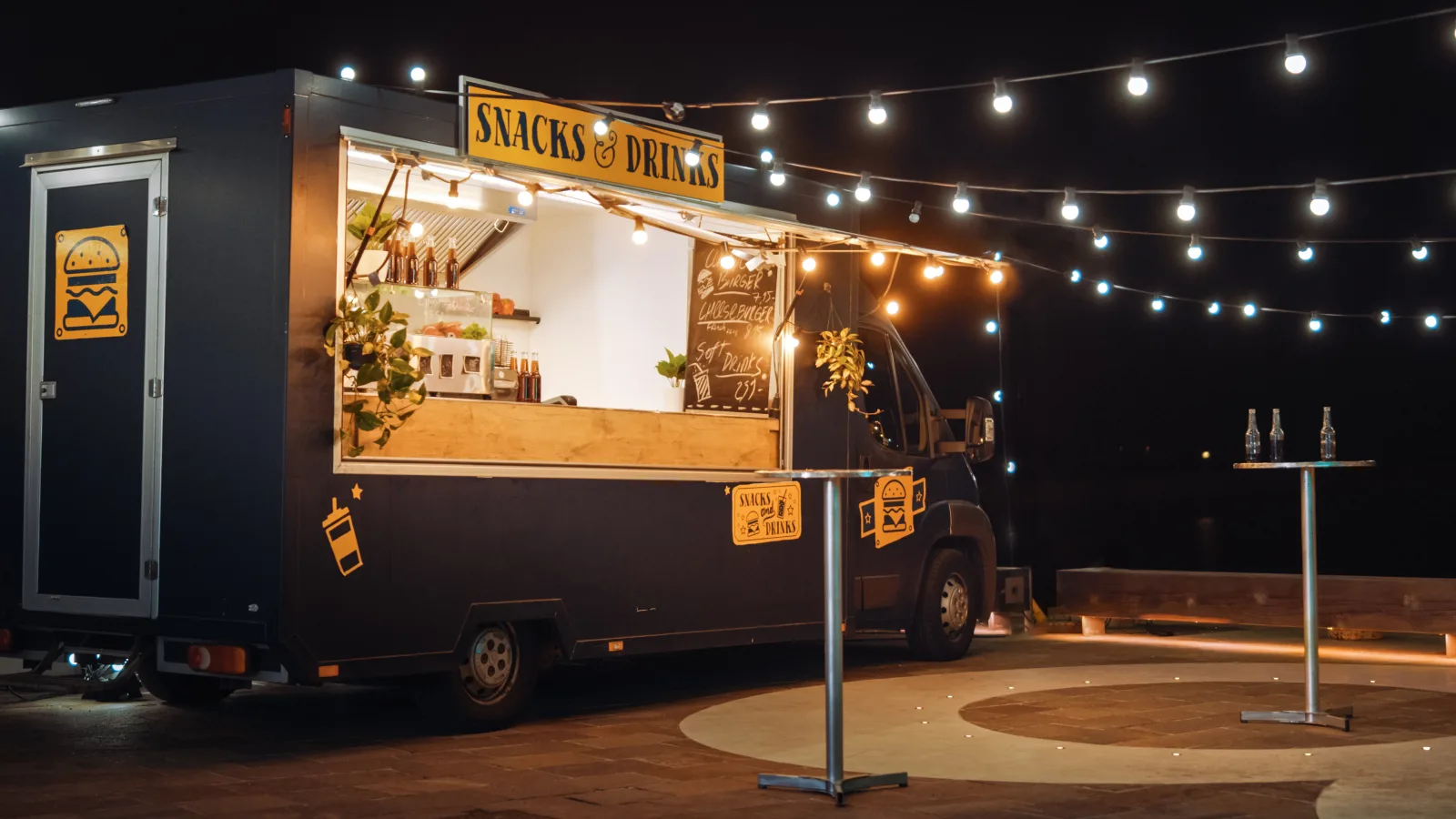

New Jersey sets a standard through a rule that issues nothing, so there is a requirement to meet and no permit to point at. Operators used to a document as proof find that disorienting. This page explains what compliance looks like when there is no credential to hold up. Documentation you assemble yourself becomes the proof, which places more weight on records than a permit state does.
The wider case — what makes any rolling food business awkward to price, wherever it trades — sits on the pillar covering food truck cover in general.
The state-specific facts here are two, and neither is what people expect. The rule that sets the standard contains no permitting scheme. And the class it defines is wide enough to include a bicycle and a boat.
Both are consequential for a submission, because a regulatory class and an insurable class are not the same object, and this is a state where the gap between them is unusually visible.
A rule that sets the standard and issues nothing
One border away, Arkansas is working from commissary and Georgia from a base of its own name.
N.J.A.C. 8:24 is titled Sanitation in Retail Food Establishments, and the title is doing exactly what it says. Read the whole of it and there is no permitting scheme: no application, no class of license, no issuing office. The body it names is the health authority, defined as the duly licensed agent of the local board of health, and the state health department for its part directs mobile operators to their local health department.
The scope of that finding needs stating precisely, because a sweeping version of it would be wrong. It is proven within this rule. It is not a claim about the whole of state law, and no licensing statute was retrieved to test whether one exists elsewhere. What can be said is that the document setting your sanitation standard is not the document that permits you, and that the department itself points somewhere local.
The working consequence is that the two halves of your regulatory position come from different places. The standard is a state text you can read from your phone. The permission is a municipal relationship you have to maintain. Operators who go looking for a single state authority to satisfy tend to find the first and assume it covers the second.
The definition is wide enough to take in a bicycle and a boat
The vehicle in this rule is a mobile retail food establishment, and the definition is broad by design: it reaches a truck, a van, a trailer, a cart, a bicycle or a watercraft. One class, six very different objects.
That breadth is sensible for a sanitation rule, which cares about how food is handled rather than about what the food is standing on. It is actively unhelpful as a guide to insurance, because those six are not one risk in any respect that matters to a policy. A cart is not registered, a trailer is towed by something that has to be insured in its own right, a watercraft leaves the auto world entirely, and only some of them can be driven away from a problem.
The failure mode here is quiet. An operator who has satisfied the health definition believes they have described their operation, and describes it the same way to a broker — as a mobile food business. The question that actually determines the policy shape is what is underneath the kitchen, and the state rule never asks it.
Servicing area is a list of four jobs, not a class of license
The base institution here is the servicing area, defined as an operating base location to which a mobile retail food establishment or transportation vehicle returns regularly for vehicle and equipment cleaning, waste discharge and water refilling. It is a functional description: the definition tells you what happens at the place rather than what the place is called on anybody’s paperwork.
The word commissary does not appear in the rule at all, so an operator here who has been handed advice about commissary agreements has been handed advice written for a different state. It may still be good advice. It is not this rule.
For a file the practical translation is that the base has to be described rather than referenced. Whose premises, permitted by whom, used on what terms, and who answers for the building, the fixed equipment and your stock while it sits there. Where the state names a license class an underwriter can infer some of that. Here nothing is inferable and it all has to be written down.
The transportation vehicle in the same sentence, which almost nobody declares
Look again at the servicing-area definition and notice what else is in it. The place is a base to which a mobile retail food establishment or a transportation vehicle returns. The rule contemplates a second vehicle — the van that carries stock, water, gas bottles and equipment between the base and the pitch — and it puts that vehicle inside the same sanitation regime as the unit itself.
Insurance conversations rarely follow. The unit is the thing people describe, because it is the thing with the name painted on it, and the support vehicle sits in a yard being treated as somebody’s car. It is not somebody’s car. It is a vehicle used in the business, carrying business property, driven by whoever is free that morning.
That is the single most common undeclared exposure on a mobile account in a dense state, and it is cheap to fix at quoting and awkward to fix afterwards. If the rule that governs your food handling has already noticed the second vehicle, the submission should have noticed it too.
A state standard, a municipal permission, and a file that has to name both
Put the two halves together and the account has a shape. One state text sets what your kitchen must do. One local office decides whether you may do it there, inspects you, and is the authority whose name belongs in your file.
That local office should be identifiable in a sentence, and for most operators here it will be more than one, because this is a state where four municipalities fit comfortably inside a short drive. An itinerary that crosses five boards of health is not unusual and is not a problem; an operator who cannot say which five is a problem, because it usually means the relationships were never really established.
The documents that decide how a claim goes are the ordinary commercial ones. The arrangement with the kitchen you work from, and whatever an event organizer, a brewery forecourt or a corporate site asked you to sign. Those contracts commonly require you to name somebody on a certificate and occasionally specify what the certificate has to say, and they get signed in the ordinary run of business without an insurance conversation attached.
Short trips, taken often, which is a frequency profile
The driving here does not look dangerous on paper. Distances are short, the pitches are close together, and an operator can work two locations in a day without leaving a small area of the map. That reads as a mild auto exposure and it is not one — a great many short journeys, into town centers and onto event sites, with reversing, kerbside setting-up and a queue forming beside a vehicle, is frequency rather than distance.
Shop and transport being a single object is enough on its own to lift the motor line up an account. Nothing here states a state duty. That check stalled before it reached a source we would defend, and rather than round it or borrow a neighbor’s we have left the space empty.
What no limit answers is who is driving. In a dense market the second pitch and the second driver arrive together, and a business running casual drivers across a support vehicle and a unit is a materially different account from an owner-operator with one set of keys. One placement note and no more: this state writes flood separately from the property form, and that question attaches to the building you work out of rather than to the truck — our New Jersey restaurant page takes the fixed-premises side of it.
Major New Jersey food_truck markets
- Newark. a working city with airport, port and shift-driven demand, where the trade is spread across hours a lunch-oriented operator does not plan for
- Jersey City. dense waterfront and transit-corridor trade inside a metropolitan orbit, with pitch competition and parking constraint as the two binding limits
- Trenton. capital-region weekday work with a government calendar behind it, and enough surrounding municipalities that a normal week crosses several health authorities
- Atlantic City. a resort and event economy where a mobile unit works alongside a large hospitality layer, and where the bookings arrive through organizers with contracts attached
- Camden. a southern-county market inside a different metropolitan orbit from the north, with waterfront event dates and a distinct set of local relationships
- New Brunswick. campus and hospital-corridor demand with a term-time rhythm, where a unit can hold a reliable weekday pitch and lose it entirely for a season
Learn more
Who we insure
Primary sources
- N.J.A.C. 8:24 — Sanitation in Retail Food Establishments — the rule itself: the servicing-area definition, the breadth of the mobile retail food establishment definition, and the absence of any permitting scheme in it
- New Jersey Department of Health — Environmental Health, retail food — the department page that sends mobile operators to their local health department rather than to the state
New Jersey food_truck insurance FAQs
Who issues a food truck permit in this state?
Not the rule that governs you. N.J.A.C. 8:24 sets the sanitation standard and contains no permitting scheme at all — the body it names is the health authority, the duly licensed agent of the local board of health — and the state health department directs mobile operators to their local health department. That finding is proven inside the rule; it is not a claim about every statute in the state.
Is a food cart or a trailer treated the same as a truck?
By the sanitation rule, yes. Its definition of a mobile retail food establishment reaches a truck, a van, a trailer, a cart, a bicycle or a watercraft, all in one class. By a policy, no: what is underneath the kitchen decides whether there is a registered vehicle to insure, a towing unit behind it, or no auto exposure of that kind at all. Do not carry the regulatory class into the insurance conversation.
Does the rule use the word commissary?
It does not. The base institution here is the servicing area — an operating base location a mobile unit or transportation vehicle returns to regularly for vehicle and equipment cleaning, waste discharge and water refilling. If you have been given guidance about commissary agreements, it was written for another state, and the terminology on your paperwork should match the rule you are actually under.
We run a van that carries stock to the pitch. Does that matter?
It matters more than most operators expect. The servicing-area definition names a transportation vehicle alongside the unit itself, so the rule has already noticed that second vehicle. Insurance submissions often have not. A van carrying gas, water and stock, driven by whoever is available, is a business auto exposure and should be declared as one.
How many health authorities will we end up dealing with?
More than one, almost certainly. This is a state where several municipalities sit inside a short drive, so an itinerary crossing four or five boards of health is ordinary rather than ambitious. The thing worth being able to state quickly is which ones, because that list is what turns an itinerary into something an underwriter can read.
Our pitches are all within a few miles. Is our auto exposure small?
Small distances, not necessarily small exposure. A great many short journeys into town centers and onto event sites, with kerbside maneuvering and a queue forming beside the vehicle, is a frequency profile. Severity comes from the fact that the vehicle is visibly a business with a kitchen inside it, and that does not shrink because the trip was short.
What auto limit does the state require?
Not on this page. The verification behind that quantity stalled, and an unfinished check published as a fact is how bad information spreads. Settle the useful things instead: the named drivers, whether a private car does work journeys, and what the support van is actually carrying.
Get a New Jersey food_truck insurance quote
Tell us what you run and where. Or call 317-942-0549.