
Food Truck Insurance · Kansas
Food truck insurance in Kansas
Kansas does something most of the states around it do not: it licenses food establishments from a state department rather than through a county board of health. For a unit that moves, that is the most consequential fact on this page.
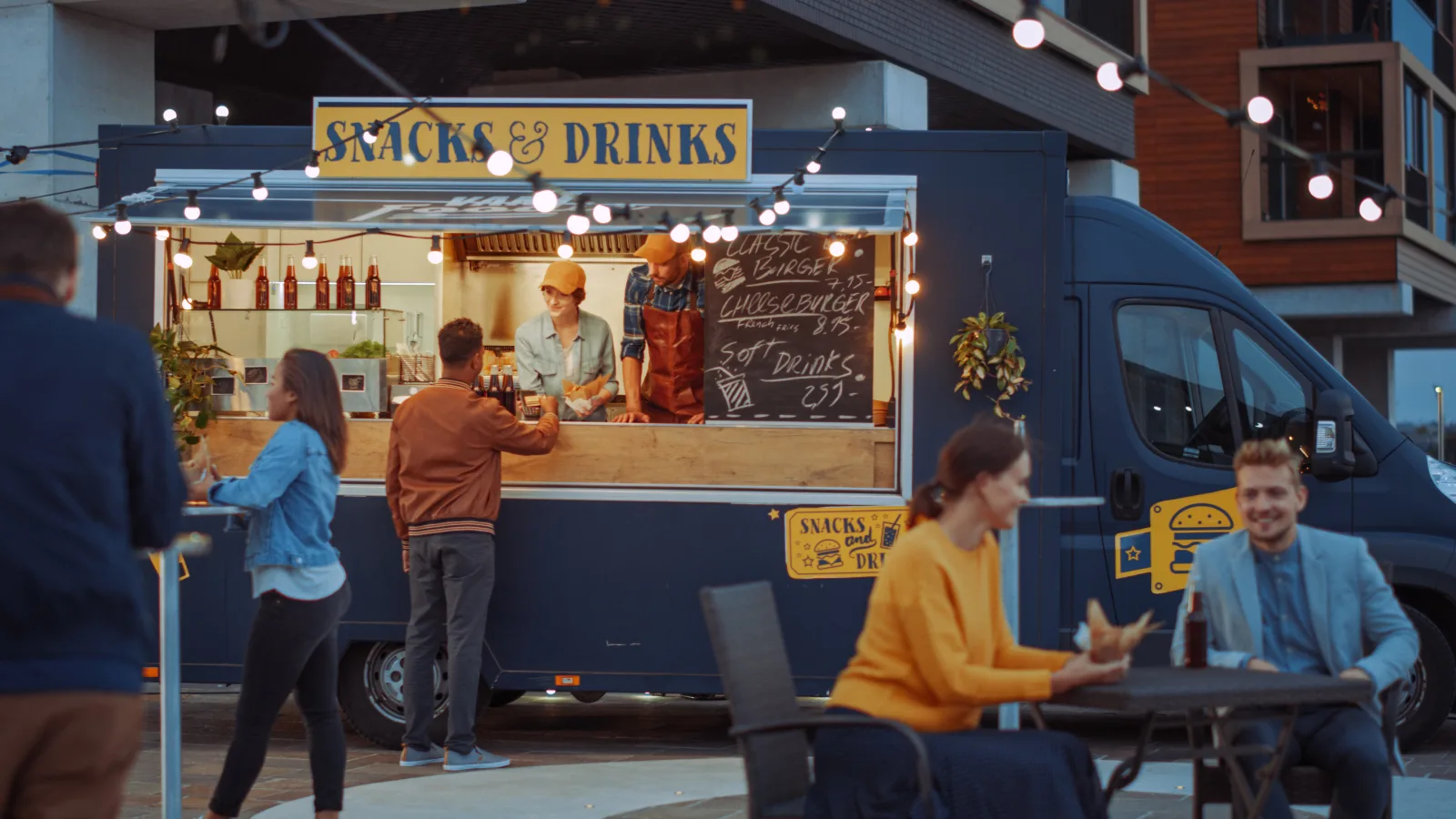

Kansas issues one license and it comes from a state department, which removes the county layer that complicates this trade almost everywhere else. The simplicity is real but it is not total. This page sets out what the single license covers and which local requirements survive alongside it. Local rules on parking, waste and signage survive the single license and will still shape where you can trade.
K.S.A. 65-689(a) makes it unlawful to conduct a food establishment without a valid license issued by the secretary, and 65-656(a) identifies that secretary as the secretary of agriculture. So the licensor is a state department. Not a health district, not a county board, not a city.
Two further definitions bring a mobile unit inside that structure. Subsection 65-656(v) defines a food establishment to include fixed or mobile restaurants, and 65-656(z) treats a mobile food establishment housed in a trailer as a food establishment with its own location — a small piece of drafting that decides how a towed unit is regarded.
None of that removes what makes this class awkward in the first place: two exposures riding on one asset, and a market whose quotes address one at a time. Our food truck insurance page carries that argument. This one covers what Kansas adds.
One license, and it comes from a state department
Between Alabama and its commissary, and Pennsylvania and its no term of its own, the institution is constant and the label is not.
For an operator who has worked in a neighboring state, this is the fact that changes the routine. The Kansas license is issued by the secretary, and the secretary is the secretary of agriculture. There is no county board of health standing between you and the license, and no health district whose boundaries you have to learn.
It is worth being precise about what that does and does not settle. It settles who issues, who inspects on that license, and whose rule set you are working under. It does not settle where you may park, how long you may stand, what a city fire official thinks about the gas on board, or what a private site will require of you before letting you trade there. Those are separate questions with separate answers, and they remain local.
On a submission, the value of a state-level license is that it is one document describing one relationship. Where a file in a locally administered state has to demonstrate a set of permissions, a Kansas file can demonstrate the license and then deal with siting separately. That is a cleaner story, and cleaner stories are quoted more accurately.
A trailer counts as a food establishment with its own location
K.S.A. 65-656(z) treats a mobile food establishment housed in a trailer as a food establishment with its own location. That sentence resolves something that is genuinely ambiguous in other states, where a towed unit sits awkwardly between being a vehicle and being a stand.
Kansas gives it a location of its own — which is to say it is a place, and it is regarded as a place even though it arrives behind something else. For an operator choosing between a self-propelled build and a trailer, that removes one uncertainty from the decision.
It does not remove the insurance consequence of the choice, which is real and runs the other way. A trailer is towed by a vehicle, and the vehicle towing it is usually the operator’s own. That is where a mobile program most often has a hole in it: the unit is scheduled, the tow vehicle is somebody’s personal truck, and nobody has asked whether a personal policy responds to towing a commercial trailer. Ask that question early. It is far cheaper before the trailer is bought.
The exceptions are why the license is not universal
K.S.A. 65-689 carries exceptions, and we can name two of them: operating fewer than seven days in a calendar year, and fundraising for community, humanitarian, educational or youth purposes. We can also tell you that those two are not the whole list, and that we are not going to enumerate a list we have not fully read.
The seven-day exception is the one that matters most to the people this page is written for, because it describes a real category of Kansas operator: somebody working a handful of dates a year, a church supper, a rodeo weekend, a single festival. That operator may sit outside the license requirement entirely.
They do not sit outside the exposure. A unit trading seven days a year cooks with the same equipment, carries the same gas, serves the same public and drives the same roads as one trading two hundred. The absence of a license obligation says nothing about whether somebody can be hurt, and an occasional operator with no cover at all is a common and entirely avoidable position.
Servicing area, and the index entry that points somewhere else
The Kansas Food Code supplies the base term and it is servicing area — the operating base a mobile establishment or transport vehicle comes back to on a regular footing to be cleaned, to have its waste discharged, to refill tanks and ice bins, and to load food.
There is exactly one occurrence of the word commissary in that Code, and it is in the index, pointing the reader to the food establishment definition. It is a cross-reference, not a definition — which means Kansas does not define a commissary, and anybody reporting that it does has counted an index entry as a rule.
That is worth knowing because the base is a real part of your file whatever it is called. If the servicing area is your building it is a fixed premises with equipment in it. If you buy time in somebody else’s, the arrangement between you decides who insures the building, who insures the equipment, and what happens to your stock overnight. Those questions are answered by an agreement, and most of these agreements are handshakes.
Whether the state license settles the county is not established here
The obvious inference from a state-issued license is that it works everywhere in the state. We are not going to publish that inference, because no provision on operating in other Kansas jurisdictions was found, in either direction.
It is a fair inference and it may well be right. It is still an inference, and this site does not present those as findings. What can be said is that no text was located either granting statewide operation or restricting the license to a jurisdiction, which leaves the question genuinely open on the material we have.
The way to close it for your own business is the same as everywhere else: ask the jurisdiction you are heading into, before you take the booking, and keep the answer. It is a short conversation, and it is a great deal shorter than the one that happens at a gate on the morning of an event.
If you are exempt and somebody is still driving your truck
Kansas offers a compensation exemption an operation this size can genuinely reach. It turns on last year’s total gross payroll measured against a stated threshold — and, crucially for a family unit, wages paid to relatives by marriage or blood are taken out of that figure before the threshold is applied at all. Our Kansas restaurant page works through the mechanics.
The mobile complication is the one the exemption does not touch. Whether or not you are inside the compensation system, somebody is driving a loaded unit on a highway at the end of a long service, and that person is either covered under the vehicle side of your program or they are not. Exemption from one obligation has never created cover under another.
So the honest advice for a small Kansas operation is to treat these as two decisions rather than one. Whether to be inside the compensation system is a genuine choice with a genuine cost. Whether the person behind the wheel is properly covered is not a choice at all, and it is the one that produces the claim that ends a small business.
Hail on a vehicle is a different form from hail on a roof
Kansas buys flood and earthquake separately, and the federal severe-storm agency names this state in its southern plains grouping — while calling the alley label a media nickname. Describe the hazard rather than the brand: hail, damaging straight-line wind and tornado, in a genuinely active corridor.
For a mobile operator the hail point is the practical one and it is unusual. Hail damage to a building is a property claim about a roof. Hail damage to a unit is a claim on the vehicle, on panels and vents and any equipment mounted on top, and it is a loss that happens while the unit is parked and unattended — often overnight, often at the base, often to several units at once if the base is shared.
That last detail is worth sitting with. Where the unit sleeps is an exposure. Covered parking, a yard rather than a street, a location out of the storm corridor: these are ordinary operational choices that quietly change the loss history of a mobile business, and they are rarely discussed because nobody thinks of a car park as an insurance decision.
Barbecue on one border, an aviation lunch trade in the middle
Kansas is not one mobile market. The eastern edge is a barbecue culture and a suburban belt with a metro across the state line; the south-central corridor runs a manufacturing lunch trade with shift patterns behind it; the wheat country supports steakhouse and café traditions and highway roadhouses; and the campus town runs on an academic year.
Those support genuinely different units. A shift-driven lunch trade rewards speed, a narrow menu and being in exactly the right place at exactly the right time. An event and roadhouse trade rewards range and a willingness to drive. A campus market rewards late hours and a tolerance for a dead summer.
They also produce different files. The lunch operator has low mileage and high daily footfall; the event operator has the reverse. An underwriter reading a description of the menu learns nothing about which of those is in front of them, and the assumption made in the absence of that information is not usually the generous one.
Major Kansas food_truck markets
- Wichita. a manufacturing-corridor market where shift patterns set the lunch trade, rewarding a unit that is in a precise place at a precise time rather than one that ranges widely
- Overland Park. a suburban office and casual-dining belt where bookings tend to be corporate, scheduled in advance and accompanied by paperwork
- Kansas City. a barbecue market on a state line, where base location and cross-border trading are practical questions rather than theoretical ones
- Topeka. a state-government market whose weekday footfall is institutional and whose weekend all but disappears, so operators build event work in to cover the shortfall
- Olathe. a growing suburban market with business-park and residential-event trade, and short driving distances between bookings
- Lawrence. a campus market that runs on the academic year rather than the weather, with concentrated term demand and a quiet summer
Learn more
Who we insure
Primary sources
- K.S.A. 65-689 — License requirements, fees, inspections — the section making it unlawful to conduct a food establishment without a license from the secretary, and carrying the exceptions that stop the license being universal
- K.S.A. 65-656 — Definitions — the definitions that make the secretary of agriculture the licensor, bring mobile restaurants inside the licensed category, and treat a trailer-housed unit as a food establishment with its own location
- Kansas Food Code — the code that supplies the base term; note that the publishing site answers a full browser header set with a 403 across its own root, so this document has to be reached in a browser rather than by a fetcher
Kansas food_truck insurance FAQs
Who issues a Kansas food truck license?
A state department. K.S.A. 65-689(a) makes it unlawful to conduct a food establishment without a valid license issued by the secretary, and 65-656(a) makes that the secretary of agriculture. There is no county board of health in the licensing path, which sets Kansas apart from most of its neighbors.
Is a towed trailer treated as a vehicle or as a premises?
As a food establishment with its own location — K.S.A. 65-656(z) says so directly. That resolves a question other states leave ambiguous. It does not resolve the insurance question underneath it, which is what tows the trailer and whether that vehicle is properly covered for towing a commercial unit.
We only trade a few days a year. Do we need a license?
There is an exception for operating fewer than seven days in a calendar year, and another for fundraising for community, humanitarian, educational or youth purposes. Those are two of the exceptions and not the whole list, so check your own position. Note that being outside the license does not put you outside the exposure — the equipment, the gas and the driving are identical.
Kansas lists commissary in its index and nowhere else. What does that mean for us?
A servicing area — the operating base a unit comes back to on a regular footing to be cleaned, to discharge waste, to refill tanks and ice bins, and to load food. The word commissary appears once in the Kansas Food Code, in the index, as a cross-reference to the food establishment definition. That is not a definition, and reporting it as one is a mistake.
Does a state license let us trade anywhere in Kansas?
It is the obvious inference and we are not going to publish it as a finding. No provision on operating in other Kansas jurisdictions was located, in either direction. Ask the jurisdiction you are traveling to before you accept the booking, and keep the answer.
Can a small Kansas operation be outside workers compensation?
Yes. The exemption turns on last year’s total gross payroll against a stated threshold, and relatives by marriage or blood are stripped out of that figure first — which is what makes it genuinely reachable for a family unit. Our Kansas restaurant page sets out the mechanics. Being outside the system is a real choice with a real cost, and it changes nothing about the driving.
Is hail a serious exposure for a food truck here?
More than operators expect, and it behaves differently from a building claim. Hail on a unit is a vehicle loss — panels, vents, roof-mounted equipment — and it usually happens while the unit is parked and unattended. Where the truck sleeps is therefore an exposure decision, and if a base yard holds several units, one storm can reach all of them.
How should we describe our trading pattern on a submission?
By mileage and by day pattern, not by menu. A shift-driven lunch operator and a regional event operator are opposite files: one has low mileage and high daily footfall, the other has the reverse. Nothing in a description of the food tells an underwriter which you are, and the default assumption in the absence of that detail is rarely the favorable one.
Get a Kansas food_truck insurance quote
Tell us what you run and where. Or call 317-942-0549.